Search results: 58
Brief description of aims and content
The goal of this module is to educate students with information technology knowledge and skills that will enable them cope with an information-rich society and continue to learn throughout their lives. This course of study identifies the essential knowledge, abilities, and attitude that all students require to be engaged lifelong learners in an information technology-rich society. The curriculum is designed to form the foundation for continuous learning and to be applicable to ever changing innovations and emerging technologies such as collaborative tools, ICT fundamentals, advanced MS Office and basic computer security. Students will be able to adapt to ever-changing technologies and use ICT skills to learn for the rest of their lives. The usual
- Lecturer: RUHUMULIZA GASPARD
- Lecturer: Kwizera Jean Pierre
- Lecturer: NZAYISENGA Marcelin
LEARNING OUTCOMES
On a successful completion, students will be able to:
- create a company.
- make company settings
- record financial transactions
- retrieve financial reports& interpret them
- export financial reports into excel&pdf
- Lecturer: HAGUMIMANA FRANK
- Lecturer: kwizera Giovani Fidele
- Lecturer: IBANDA Hassan
Brief Description of aims and content (not more than five lines)
The module aims to cover applied linguistics and second
language acquisition/learning theories, stages in second language acquisition/learning, language learning
and teaching, factors affecting second language learning, styles and
differences in language learning, contrastive analysis and error analysis; and have an overview on language testing
and assessment
- Lecturer: RUHUMULIZA GASPARD
- Lecturer: Jacques Ndahayo
This module is designed to provide students with an understanding of corporate governance and the various corporate governance systems with a specific emphasis on listed public companies. It thus provides a framework for analysing how different stakeholders, both internally and externally, influence the behaviour of actors within a company
6.2 Learning Outcomes
Knowledge and Understanding
Having successfully completed the module, students should be able to demonstrate knowledge and understanding of:
Identify and explain the main themes, perspectives and issues in the area of corporate governance.
Cognitive/Intellectual skills/Application of Knowledge
Having successfully completed the module, students should be able to:
Describe the role and the development of corporate governance, particularly its different models
Communication/ICT/Numeracy/Analytic Techniques/Practical Skills
Having successfully completed the module, students should be able to:
Describe and appraise corporate governance in Ireland as well as differentiate between international differences in systems of corporate governance.
Discuss in an informed way the development of corporate governance structures.
Analyze and discuss the influence of different stakeholders on the behavior of actors within a company
- Lecturer: JACKSON KAGOBORA
- Lecturer: NSABIMANA William
- Lecturer: Rutarindwa Jean Pierre
- Lecturer: Dr. Abdullahi Musa Yola
- Lecturer: ngabo espoir
- Lecturer: IBANDA Hassan
- Lecturer: ngabo espoir
- Lecturer: IBANDA Hassan
Brief description of aims and content
The module introduces the basic concepts and principles of electrostatics, magneto statics, Maxwell Equations, propagation of electromagnetic waves, and their applications. The main aim of the module is to allow the student to explain electricity and magnetism phenomena, solve problem, perform experiments related to electricity and magnetism and apply teaching and learning strategies related to electricity and magnetism.
- Lecturer: RUHUMULIZA GASPARD
- Lecturer: Theoneste NIYITANGA
By the end of this course, students will be able to:
-
Explain core concepts and theories in psycholinguistics related to language comprehension, production, and acquisition.
-
Describe the cognitive and neurological processes involved in understanding and producing spoken and written language.
-
Analyze language phenomena such as slips of the tongue, speech errors, and sentence processing using psycholinguistic principles.
-
Identify major brain structures associated with language and explain their roles in linguistic functioning.
-
Discuss language disorders (e.g., aphasia, dyslexia) and relate them to underlying cognitive and neurological mechanisms.
-
Apply psycholinguistic knowledge to real-world contexts such as education, communication, and language learning.
-
Evaluate basic research methods used in psycholinguistics and interpret findings from experimental studies.
These outcomes equip students with both theoretical understanding and practical insight into how language operates in the human mind and brain.
- Lecturer: Rukundo Desire
- Lecturer: Mpumuje Maurice
Welcome to the Fundamentals of C Programming module! In this foundational course, we embark on an exciting journey into the world of programming with one of the most influential and enduring languages: C. Designed to provide a solid understanding of programming concepts and techniques, this module serves as the gateway to mastering the art of computer programming.
Throughout this module, you will delve into the core principles of C programming, learning essential syntax, data types, control structures, functions, and more. Whether you're a beginner seeking to grasp the basics or an experienced programmer aiming to reinforce your skills, this course offers a comprehensive exploration of C's fundamentals.
By the end of this module, you'll not only have a firm grasp of C syntax and programming principles but also a deeper appreciation for the elegance and power of this timeless language. Get ready to unlock the secrets of programming and embark on a journey that will shape your understanding of computer science and software development.
- Lecturer: Isaac TUMWINE
C programming module provides an introduction to the C programming language, covering its syntax, features, and fundamental concepts. Students learn about variables, data types, control structures, functions, arrays, pointers, memory management, structures, unions, file handling, and more. The module may delve into advanced topics like multi-dimensional arrays, function pointers, and preprocessor directives. Practical exercises and projects are often included to reinforce learning and practical application of C programming concepts.
- Lecturer: Isaac TUMWINE
In a C programming course, you'll build your coding skills from the ground up, learning about variables, data types, and control flow. You'll work with arrays to organize data and write functions to create reusable code. By the end, you'll be ready to tackle your own programming projects in C.
- Lecturer: Isaac TUMWINE
Brief description of aims and content
This module defines and describes psychology and its principles as well as genesis, with the aim to describe and explain processes of psychological evolution of human being from the childhood to the adulthood. It also addresses the principles of human learning as they relate to teaching and learning from selected theorists in the field of educational psychology.
- Lecturer: RUHUMULIZA GASPARD
- Lecturer: KAMUKAMA JIMMY SPICE
- Lecturer: SALONGO MUYOBOKE
REPUBLIC OF RWANDA
KIGALI INDEPENDENT UNIVERSITY ULK
P.O Box 2280
Website://www.ulk.ac.rw
This is an interactive instructional module that
uses both action and collaborative learning styles that provide you with diverse online learning
experiences and effective learning processes. This should hopefully equip you with the necessary
attitudes, knowledge and skills crucial in the implementation of human rights as a cross cutting
issue to all domains of life and the consideration of present generation to meet his needs without
compromising the ability of future generation to meet their owns needs.
- Lecturer: SEBUHURA KALALA
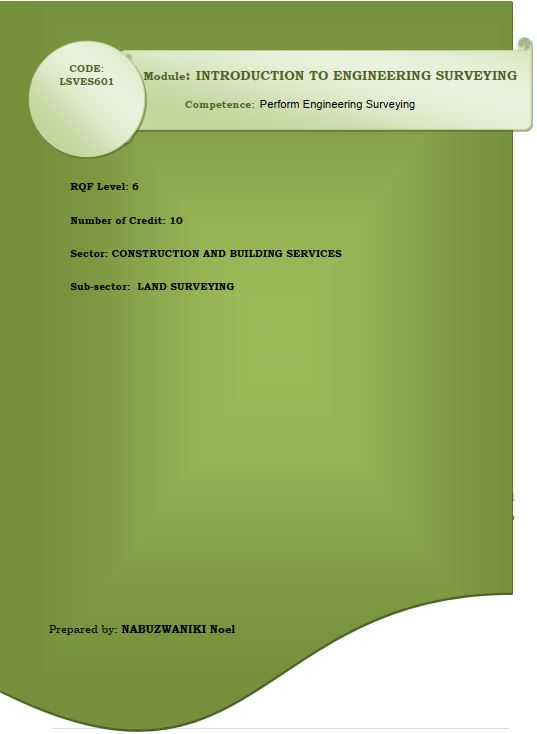
### **Course Summary: Engineering Surveying**
This module provides foundational knowledge and practical skills in **engineering surveying**, covering key concepts such as **linear measurement, levelling, cross-section area computation, earthwork volume calculation, and angular measurements**.
#### **Key Learning Outcomes:**
By the end of this module, trainees will be able to:
1. **Describe the basics of surveying**, including:
- History, purpose, and importance of surveying.
- Classification of surveying (plane vs. geodetic, control surveys, layout surveys, etc.).
- Principles of surveying (working from whole to part, consistency, accuracy, independent checks).
- Units of measurement and error correction techniques.
2. **Perform linear measurements** using:
- **Direct methods** (pacing, odometer, chaining, taping).
- **Indirect/optical methods** (tacheometry, triangulation, slope angle measurement).
- **Electronic methods** (EDM, DGPS).
3. **Conduct levelling operations**, including:
- Basic principles and terminology (benchmarks, reduced levels, datum).
- Methods (direct levelling, trigonometric levelling).
- Field procedures (two-peg test, booking using rise & fall and height of collimation methods).
- Error correction (curvature, refraction, loop closure).
- Contour mapping (interpolation, characteristics, and applications).
4. **Compute cross-section areas and earthwork volumes** using:
- **Area calculation methods** (mid-ordinate rule, trapezoidal rule, Simpson’s rule).
- **Volume estimation techniques** (average end-area method, prismoidal formula, spot height method).
5. **Measure and compute angles**, including:
- Types of angles (horizontal, vertical, zenith).
- Measurement units (degrees, radians, gradians).
- Tools (theodolite, optical square, surveyor’s compass).
- Methods (bearing, azimuth, angle direction).
#### **Key Takeaways:**
- Surveying is essential for **construction, mapping, land development, and infrastructure projects**.
- Proper **error management** (systematic, random, gross) ensures measurement accuracy.
- Modern tools like **total stations, DGPS, and EDM** enhance precision and efficiency.
- **Levelling and contouring** help in terrain analysis and design.
- **Earthwork computations** are crucial for excavation, embankment, and cost estimation.
This course equips trainees with **practical surveying skills** applicable in civil engineering, construction, and geospatial projects.
- Lecturer: NABUZWANIKI Noel
The module "Introduction to Law" provides a foundational understanding of the nature, purpose, and structure of law within society. It introduces students to basic legal concepts, classifications of law (such as public and private law), sources of law, and the role of legal institutions in maintaining order and justice. This course also explores fundamental legal principles such as the rule of law, justice, legal personality, and the distinction between moral and legal rules. Through this module, students will gain essential knowledge and analytical skills that prepare them for advanced legal studies and help them appreciate the importance of law in regulating human behavior and resolving social conflicts. It serves as the cornerstone for all future legal learning and professional development.
- Lecturer: Uwera Mamy
To help students understand the multilingual conditions of language learning, this module defines multilingualism from different perspectives (number of languages in the world, status of different languages, etc.); presents the patterns of multilingualism in different nations and explains their settings; and describes the multilingual practices obtaining in different contexts. It further presents a historical overview of traditional and contemporary perspectives on L1 and L2 acquisition/learning and draws on perspectives on multilingualism to explain the current paradigm shift from monolingual to multilingual views on language acquisition/learning, and the effects of multilingualism on language learning.
- Lecturer: RUHUMULIZA GASPARD
- Lecturer: Mugisho Ndabuli
- Lecturer: Mugisho Ndabuli
- Lecturer: IBANDA Hassan
- Lecturer: Rutarindwa Jean Pierre
- Lecturer: Martins Onuorah
- Lecturer: Rutarindwa Jean Pierre
- Lecturer: Martins Onuorah
- Lecturer: Jean Claude HABIMANA
- Lecturer: Rutarindwa Jean Pierre
- Lecturer: NYAKURI JEAN PIERRE
- Lecturer: karikurubu emmanuel
- Lecturer: NYAKURI JEAN PIERRE
- Lecturer: IBANDA Hassan
- Lecturer: IBANDA Hassan
- Lecturer: IBANDA Hassan
Brief description of aims and content
This module lays the foundations to the study of Finance and introduces the fundamental concepts of money and banking. It focuses particularly on introduction to theoretical and applied issues relating to the banking industry. It introduces to banking, central banking and banking regulations issues in bank management and comparative banking markets.
Learning Outcomes
At
the end of this course, students have a clear understanding about
- Monetary policy
- Central Banking
- Banking Regulations
- Issues in Bank Management
- Techniques and Practices of Banks
- Comparative Banking Markets.
- Lecturer: NSABIMANA William
- Lecturer: Jean Damascene MUSHIMIYIMANA
- Lecturer: KABAYIZA CLEMENT
- Lecturer: Birali Steven
- Lecturer: KABAYIZA CLEMENT
- Lecturer: Birali Steven
- Lecturer: KABAYIZA CLEMENT
- Lecturer: Birali Steven
- Lecturer: Birali Steven
- Lecturer: Jean Bosco NKURIKIYIMFURA
- Lecturer: Birali Steven
- Lecturer: Jean Damascene MUSHIMIYIMANA
- Lecturer: Birali Steven
- Lecturer: KABAYIZA CLEMENT
- Lecturer: Birali Steven
- Lecturer: KABAYIZA CLEMENT
- Lecturer: KABAYIZA CLEMENT
- Lecturer: Jean Damascene MUSHIMIYIMANA
- Lecturer: Jean Damascene MUSHIMIYIMANA
- Lecturer: Jean Damascene MUSHIMIYIMANA
- Lecturer: KABAYIZA CLEMENT
- Lecturer: Jean Bosco NKURIKIYIMFURA
- Lecturer: Jean Bosco NKURIKIYIMFURA
- Lecturer: KABAYIZA CLEMENT
- Lecturer: NSHIMIYIMANA Thacien
- Lecturer: NSHIMIYIMANA Thacien
This module describes the skills, knowledge and right attitudes required to match the learning process with occupation, develop action plan to meet occupation standards and relate occupation with the labor market demand. This module is intended for trainees pursuing Advanced Diploma in all engineering trades. The trainees will be able to identify the occupation and its learning processes. They will also be able to integrate in the working environment, set out the goals to perform the occupation and self assessment. This module encourages greater motivation and, subsequently, a better integration of various learning. The trainees will be able to independently develop a comprehensive and clear vision of the occupation and training programme at professional level.
- Lecturer: GABRIEL UWANYIRIGIRA
- Lecturer: GABRIEL UWANYIRIGIRA
- Lecturer: GABRIEL UWANYIRIGIRA
Brief description of aims and content
This module aims at introducing the student-teacher to concepts of Special Needs Education, characteristics of special need learners, skills and strategies required for providing special needs education, features of effective inclusive education, challenges to special needs education delivery, approaches to inclusive education. It introduces students to inclusive education and child friendly approaches. Students will learn key concepts, practices and contexts related to Special Needs Education (SNE), Inclusive Education (IE), and Child Friendly School concept and practices (CFS) that make school community an effective center for learning. It enhances learners „social and physical development as well as emotional well-being and gender responsiveness.
- Lecturer: RUHUMULIZA GASPARD
- Lecturer: Aimable SIBOMANA
Hello learners,
Welcome to the EDM 103 Module - Theories and Practices of Teaching.
My name is Dr David Ngatia and I will be your course lecturer.
This course aims to equip you with a comprehensive understanding of teaching theories and practices by providing you with the knowledge, skills and values necessary to create engaging, effective, and inclusive learning environments.
Hope you will enjoy the course!
Email Contact: dgachiu@gmail.com Moblie-WhatsApp: +254 725620042
- Lecturer: Rukundo Desire
- Lecturer: David Ngatia
Brief description of aims and content
This module aims to define and explain the basic concepts in education such as teaching, learning, learner, teacher etc. communication in the teaching-learning, approaches to teaching-learning pedagogy, concept of learner-cantered pedagogy, theories of learning, teaching-learning principles and methods, Factors guiding choice of teaching-learning methods, types of educational taxonomies -cognitive, affective, and psychomotor levels of educational objectives.
- Lecturer: RUHUMULIZA GASPARD
- Lecturer: KAMUKAMA JIMMY SPICE
- Lecturer: IBANDA Hassan